 Qukla
Weekly business summary
Gathers each area's numbers into one page, showing what changed.
Why it stays human-shaped: The owner sees everything without chasing anyone.

In four weeks, Qukla maps how work moves across your business, finds where AI creates real value, checks the tools behind each process and gives your leadership a clear roadmap built on evidence, not hype.
Qukla is part of the Luxora Consulting group.
We document processes with the people who do them, on their own screens.
Each tool is verified against official documentation, and the link is kept.
The first use case has a baseline before anything is built.
Your leadership approves the roadmap, not a black box.
They keep the work useful to the people who will live with it.
Every process exists for the customer, for the business and for the employee. If the AI version loses one of the three, it is not ready.
We place every task at one level. Anything that reaches a customer or the public starts as Person with AI.
Before touching anything we record today's number: hours per week, delay, backlog, errors. Without it, nobody can say if it worked.
The mapping is done by talking, not by filling in spreadsheets. AI writes up the conversations; people review and decide.
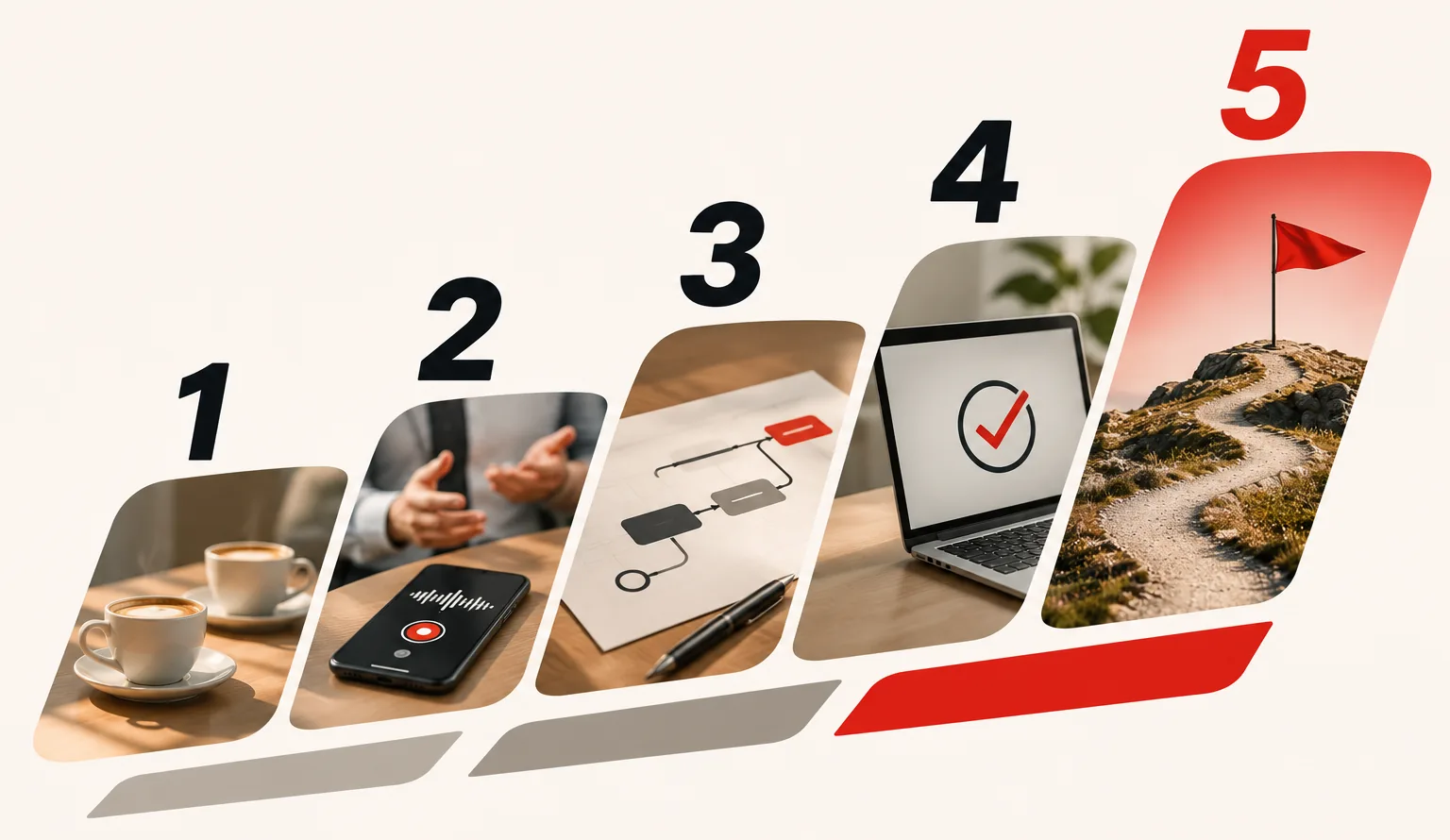
We agree the areas in scope and who leads each one.
→ Scope and contactsOne recorded conversation with each area lead, with consent. AI turns it into a list of processes.
→ Process list per areaWe sit with the person who does each task, on their screen. One sheet per process, with the three reasons.
→ Sheets approved by the doerEach tool in each step is checked against its official documentation, with the link. No source means "to confirm".
→ Software mapAI proposes an order; your management decides. The first case is measured before we build.
→ Approved roadmap



We cover four more points in the same conversations, so the plan holds when it meets reality.

Which data each process uses, where it lives, who owns it, its quality and whether it is personal or sensitive.
What goes wrong, how often and who fixes it, and the process end to end between areas, where the pain usually is.
Impact of an AI error, GDPR and the EU AI Act, DORA or NIS2 where they apply, who signs off, and an audit trail.
Who is on board, which AI tools are already used informally, and what training each role needs.
Examples by role, to start the conversation. Each one is checked with the person who does the task before anything is built.
Gathers each area's numbers into one page, showing what changed.
Why it stays human-shaped: The owner sees everything without chasing anyone.
Flags when sales, collections or stock drift from normal.
Why it stays human-shaped: Know in time, not at month-end.
Summarises the options, differences and risks of each proposal.
Why it stays human-shaped: The decision stays with you, with everything in view.
Asks for missing details and ranks enquiries by potential.
Why it stays human-shaped: Sales time goes to people who will buy.
Spots proposals with no reply and drafts the follow-up.
Why it stays human-shaped: A proposal without follow-up is lost.
Turns the call or chat into a CRM record.
Why it stays human-shaped: Salespeople hate data entry; the business needs the data.
Drafts the answer from current, approved information.
Why it stays human-shaped: Fast and right, approved by a person.
Looks up the status and prepares the reply.
Why it stays human-shaped: The customer should not have to ask twice.
Groups the month's complaints by cause and by area.
Why it stays human-shaped: Fix the cause, not the symptom.
Reads invoices and enters them in your system.
Why it stays human-shaped: Every cost recorded correctly.
Matches bank movements to invoices and flags differences.
Why it stays human-shaped: The numbers add up at close.
Collects and orders the month's documents.
Why it stays human-shaped: Month-end closes on time.
Prepares a friendly reminder for each invoice falling due.
Why it stays human-shaped: Get paid without upsetting the customer.
Logs each promise and flags the ones that are missed.
Why it stays human-shaped: No promise is forgotten.
Flags customers who have started paying late.
Why it stays human-shaped: Act before it grows.
Reads orders from e-mail, WhatsApp or spreadsheets and enters them.
Why it stays human-shaped: An order entered wrong ships wrong.
Warns before items run out.
Why it stays human-shaped: Restock in time.
Groups deliveries by area and time window.
Why it stays human-shaped: The driver knows the road and approves the route.
Person with AI: AI prepares, a person approves. Agent: AI does internal, rule-based work and a person reviews samples.
The kind of change a diagnostic usually finds. Each step keeps its level, and a person stays in charge of what reaches the customer.
What we measure first: minutes per invoice, entry errors, documents missing at close
What we measure first: order entry errors, time to confirm, "where is my order?" questions
A fixed scope that ends in a decision, not a report that sits in a drawer.
Done when:
Each area has its list of processes, reviewed by its lead.
Done when:
The selected processes have their sheet, recognised by the people who do them.
Done when:
Every tool has a status backed by official documentation.
Done when:
Management approves the order, and the first case has a week of measurement.
No. What you already use comes first. A change of tool is only considered when a step cannot be connected in any way, and we say so with the official source.
About an hour with each area lead and an hour with each person whose process is selected. The rest is our work.
Conversations are recorded only with consent, kept in a restricted folder, and customer data stays out of the process sheets.
That is not the aim. Anything that reaches a customer is approved by a person, and each sheet records what the person wants to keep in their own hands.
We reply within two working days, from the Luxora Consulting team.
Or write to us at qukla@luxora.consulting